




By Litza Coello, Sales & PD, High Tech Tomato
I split my time between Product Development and Sales for High-Tech Tomato, based in Leamington, Ontario, home to the largest concentration of greenhouses in North America. My first five months have been focused on reconnecting with trial partners, expanding our program, and raising awareness of our growing North American high-tech tomato program.
Earlier this September, I joined my European colleagues in the Netherlands for an internal alignment meeting, where decisions are made on which varieties will advance in the year ahead. One topic surfaced in almost every technical session, regardless of the segment: labor costs. And one potential solution kept coming up in different forms: automation.
For tomatoes, that conversation quickly turns to harvesting robots and how much their success depends on breeding, not just engineering. The topic was relevant enough that several of us began exploring ideas around breeding tomatoes specifically for automated harvesting systems. One concept that particularly caught my attention was selecting for plant architectures that distribute more uniformly along the row, allowing robotic systems to locate and harvest fruit more consistently.
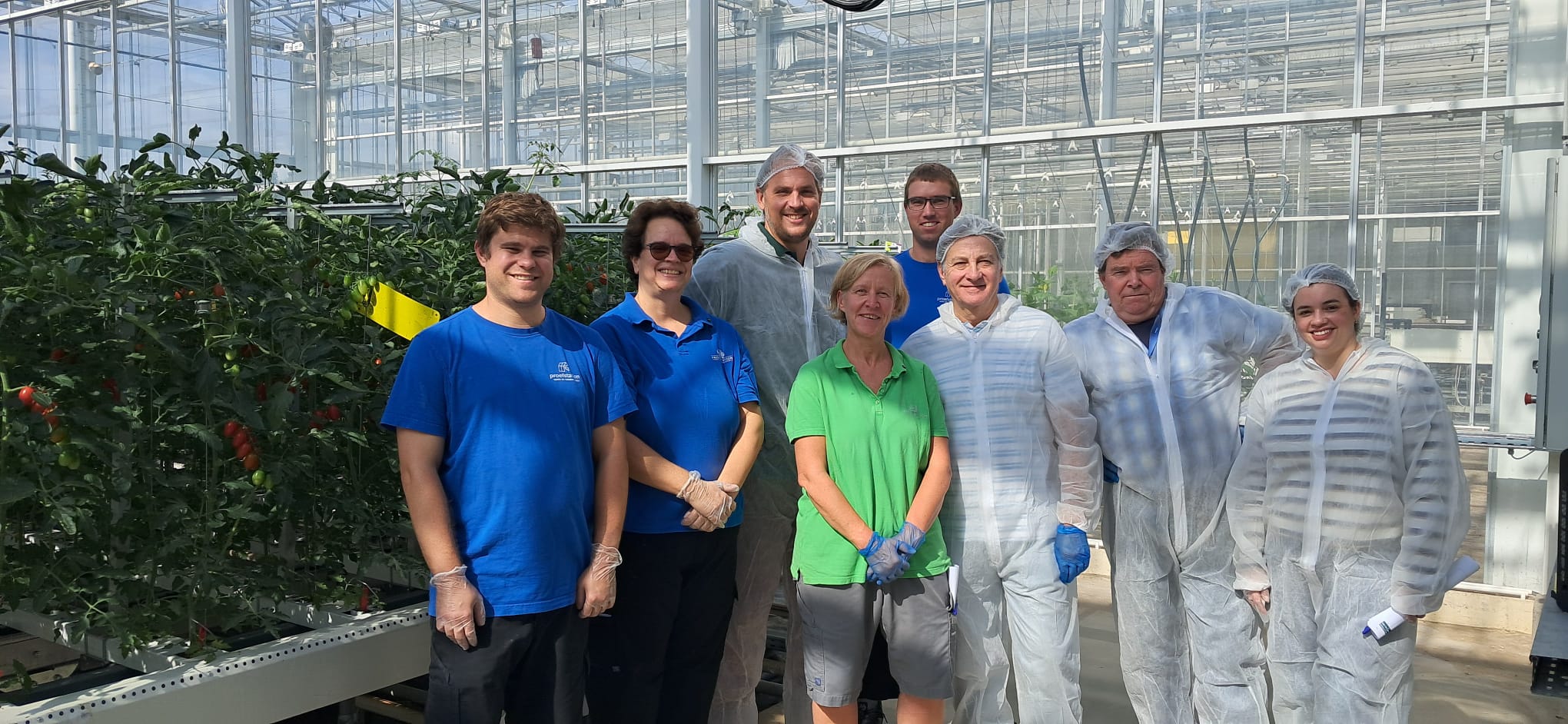
This idea stayed with me because it is already being put into practice. During my trip, I also had the opportunity to visit Harvestis, Belgium’s applied research center for vegetables and strawberries. There, I saw the TOM 4.0 project up close, a collaboration between Ridder, Hortiplan, and Van der Hoeven Horticultural Projects.
The project takes a fundamentally different approach to crop production: compact, two-truss tomato plants grown on mobile gutters that move between climate zones, with harvesting and replanting taking place on a weekly cycle. Early simulations for TOM 4.0 indicate a potential 20% increase in production compared with conventional high-wire growing, largely thanks to more efficient use of light on young plants.
Equally important is staying close to the growers and retailers who work directly with our varieties. Their perspectives, further along the value chain, are essential in shaping our priorities, just as much as the data we gather from trials.
While automation represents a longer-term shift, progress in our pipeline continues today. A recent milestone has been the advancement of new large-cluster and cherry-truss hybrids, two segments where our North American program previously had limited options.
Our next step is to build on this momentum in Western Canada and expand further into the US and Mexico.
Automation may eventually reach a tipping point and transform how tomatoes are grown and harvested. For now, my focus remains on what lies immediately ahead: addressing the challenges our growers face today and advancing varieties that help meet their needs.


